“We have to be more like John Lewis . . . ”
Thursday, July 30, 2020
Tuesday, January 21, 2020
Suggestion or Statement?
I recently made the comment that a suggestion is often better than a statement. It was one of those moments—fairly rare in the life of an introvert—when I felt the words come out of my mouth before I had thought them through. Afterward, I kept
hearing myself say: A suggestion is often better than a
statement. It felt right, but what did it mean? My intuition grasped it before my mind.A suggestion—like a hint or a clue—elicits curiosity, mental engagement, and emotional response, inviting discussion and participation. The follow-up to a suggestion is often: “What are you suggesting?” On the other hand, a statement is settled business, and much like a proclamation, statements are intended to end discussion and debate—close it down, shut it off. Case closed.
Suggestions are powerful because they raise questions and prepare the way for a flow of memories, thoughts, and ideas. A thin cotton curtain blowing in an open window, animal tracks in the snow, a leaf lying all by itself on a rock, a single bird's feather lying on ground—such images, whether presented visually or literarily, toy with one's thoughts and imagination. And imagination—both personal and communal—need I speak of its importance in the life of an individual and a society?
The exercise of imagination is dangerous to those who profit from the way things are because it has the power to show that the way things are is not permanent, not universal, not necessary. —Ursula K. Le Guin
Art—in all its varied forms—is never a statement; it is always a suggestion. There is always more
to art than what meets the eye. Art offers a hint and entices the viewer to finish the story . . . in their own way, using their own imagination, drawing from their own personal experiences.
There it is . . . the power of suggestion.
Wednesday, January 8, 2020
from Be Here Now, by Baba Ram Dass
And he'd say, "Don't think about the past. Just be here now."
Silence.
And I'd say, "How long do you think we're going to be on this trip?"
And he'd say, "Don't think about the future. Just be here now."
I'd say, "You know, I really feel crumby, my hips are hurting . . ."
"Emotions are like waves. Watch them disappear in the distance on the vast
calm ocean."
He had just sort of wiped out my whole game. That was it—that was my whole trip—emotions, and past experiences, and future plans.
_________________________
I wonder: What are we left with when we lose our "whole game?" What are we left with if we lose our past, lose our future, lose our emotional reactions? All we have is this moment . . . right now. We lose our "whole game," but what do we gain?
Friday, October 18, 2019
Elijah Cummings Will Be Missed
![]() |
| Elijah Cummings died October 17, 2019 |
Monday, September 23, 2019
Spellbound
I walked down to the hill at dusk today. A freaky warm day after a few weeks of refreshing, cool weather. Even late in the day, the air was warm and heavy, almost oppressive.
Seemingly overnight, greens in the woods have begun to disappear, replaced by yellow, brown, orange, tan, red. Standing at the top of the hill in the low light of the evening, looking down at the expansive fern beds, I was held spellbound.
As beautiful as the ferns are in the spring—fresh, bright green, elegant—they are stunning in the fall—the color of sweet hay, relaxed, even slouching against one another, proudly showing the wear and tear of the summer season. I stood there until dark. Spellbound.
Seemingly overnight, greens in the woods have begun to disappear, replaced by yellow, brown, orange, tan, red. Standing at the top of the hill in the low light of the evening, looking down at the expansive fern beds, I was held spellbound.
As beautiful as the ferns are in the spring—fresh, bright green, elegant—they are stunning in the fall—the color of sweet hay, relaxed, even slouching against one another, proudly showing the wear and tear of the summer season. I stood there until dark. Spellbound.
Thursday, August 30, 2018
Gliding through Time
I go out on the pond in my kayak shortly before the sun is
to set. I paddle out of our cove and turn south towards the stream. An
eight-minute paddle and I hit the shallow water just before the stream. This is
my favorite part—the rushes. I pick up speed as I approach them, paddling as
strongly as I can. The rushes are sturdy, tall, dark green, and resilient. I hit the rushes, hold my paddle up
high, and glide. It’s magical. The sound of the rushes rubbing on my kayak, the sight
of the rushes parting as my kayak passes through, the shimmer of the water, the
zig-zag reflection of the rushes in the water, the red dimple right where the rushes meet the water. The sight, the sound—I never tire of it. I pull the brim
of my hat down low, so all I see are the rushes and the water. Sometimes I close
my eyes so I can focus on that wonderful sound made by the rushes rubbing on the
kayak. And the feeling that comes with gliding on the water . . . so smooth,
free, simple . . . no bumps, bottlenecks, stumbling blocks, or barriers. Just
the luxurious feeling of gliding . . . and realizing that nothing really matters. Saturday, December 23, 2017
The Progress of the Seasons
My friends ask what I will do when I get there. Will it not be employment enough to watch the progress of the seasons?
— Henry David Thoreau, “December 24, 1841”
Wednesday, November 1, 2017
The Eight-Foot Stump
It's Wednesday and we've not had power since Monday. They say it may be a few more days. So, I'm cooking—or rather warming things up and boiling water for tea—on our little backpacking stove; running a generator for the refrigerator, freezer, and one lamp; keeping the wood stove going for heat; and visiting my friend in town for showers and buckets of water—she has power. I can access wifi through my personal hotspot on my iPhone, so I'm connected. I can keep up with the news, get updates on the power outage, and get some work done. But, it's not too bad. I'm warm and fed and comfortable.
![]() |
| source |
![]() |
| source |
In the spring we cleared out all the debris, and the changes in the woods were very noticeable. A birch was bent over almost to the ground, making a circle; it never again stood tall and straight. A big oak lost lots of limbs and looked very tall but not at all wide. Some trees split or tore and fell, leaving ragged stumps of varying heights. The effects of the ice storm were apparent for several years, but eventually the birch tree that made a circle died. The big oak recovered its breadth and looks perfectly normal to this day. Some trees made it, others did not.The eight-foot stump from the maple that fell at the edge of the lawn stayed there after we cleared away the rest of tree. I would often look at it and remember that I watched it fall to its death. The stump slowly rotted, and I pushed it over just last summer. After seventeen years, it was so rotten I could push it over with one hand and little effort. It went on to pass its nutrients back to the earth.
This week's storm was rain and strong wind, so trees and limbs fell, not from the weight of ice, but from the force of wind. We lost one big tree, a poplar I think. It broke off about 15 feet above the ground. At the break point, there's a big hollow area, which was probably begun by a busy woodpecker and eventually became home to mice or squirrels. But they're gone now, and soon we'll cut up the tree in hopes that some of it at least will make good firewood.
That's how it works. The rhythm of life. Creation and destruction. Rotting and recovery. We long remember the events that are bigger than the norm. We use them to mark time. Eventually, though, they too fall away as our memories fade and we are one day laid onto the ground. And in that spot there will one day be a beautiful maple or perhaps an oak, standing tall and broad.
This week's storm was rain and strong wind, so trees and limbs fell, not from the weight of ice, but from the force of wind. We lost one big tree, a poplar I think. It broke off about 15 feet above the ground. At the break point, there's a big hollow area, which was probably begun by a busy woodpecker and eventually became home to mice or squirrels. But they're gone now, and soon we'll cut up the tree in hopes that some of it at least will make good firewood.
That's how it works. The rhythm of life. Creation and destruction. Rotting and recovery. We long remember the events that are bigger than the norm. We use them to mark time. Eventually, though, they too fall away as our memories fade and we are one day laid onto the ground. And in that spot there will one day be a beautiful maple or perhaps an oak, standing tall and broad.
Friday, August 25, 2017
Essence
I'm reading the interpretation of the daodejing by David Breeden, Wally Swist, and Steven Schroeder. These three lines caught my attention today.
Reaching, we find edges.
Without reaching,
We find essence.
Artists--visual artists, literary artists, performing artists--seek essence, crave essence. That's the nature of art; it's a pathway to essence, a window looking out on essence, an encounter with essence. No reaching involved. When artists make art, everything drops away and essence presents itself.
Bliss.
Wednesday, June 28, 2017
Forgiveness
Tuesday, January 17, 2017
Green Bay Packers: A Celebration of Persistence and Resilience
January...time to recover from the holidays, clean the house, watch the days get longer, play in the snow, and watch playoff football. I love football! What's not to love? It's all about trying to reach the goal, overcoming obstacles, sometimes getting pushed back, changing strategy, and, with practice, skill, and a bit of luck, sometimes bursting ahead with everyone cheering you on. It's life. It's who we are. Moving forward. Never giving up.
Let me be very clear; I'm a Packers fan. I was born in Milwaukee, German and Polish heritage, third generation, I believe. I didn't live there long—we moved to California when I was six—but it stayed with me nonetheless. Gimbals department store, Quality Candy Easter cream eggs, Pabst beer (the only kind my father drank), a family bar on every corner, Friday fish fries, cheese, sausage, cold weather, piles of snow...and the Green Bay Packers, Vince Lombardi, Bart Starr, and Paul Hornung. I grew up hearing those names over and over. My father watched the games in his "man cave," which was also our garage. He'd sit there in front of his tiny black-and-white TV set with his Pabst; our boxer, Heidi, by his side, occasionally licking his empty beer glass; and I'd be running in and out, riding my bike, playing hopscotch or four-square with my friends. My father would call out, "they ran it in for a touchdown," "only two minutes left," "come, watch!"
Once I left home, I didn't think much about football, but when life settled down to an easy, comfortable rhythm, I started watching games again. By that time, Brett Favre was the quarterback. You had to love him; he made it look so easy and always looked like he was having so much fun. This Mississippi boy was known for never losing when the temperature was below 32 degrees, and when isn't it below 32 in Green Bay? Fog pouring out of the players' mouths; snow falling; fans bundled up in parkas and scarves and mittens, hunks of fake cheese on their heads; players standing on the sideline wearing those enormous football-player capes to stay warm. It all hit a very tender spot inside me, the part of me that is still so much about Milwaukee, and I was hooked. I live in Maine now, and when the Packers game is televised here, it's a great day. My husband makes a great big pizza with lots of onions and sausage, chills the beer glasses, and we settle in to enjoy a cozy afternoon.
These days it's Aaron Rodgers, Jordy Nelson, Clay Matthews, Randall Cobb, Mike McCarthy. Sunday's game against the Cowboys couldn't have been better. Packers took a big lead early in the game, the Cowboys fought back to tie the score (twice) in the last few minutes, and Rodgers, always looking cool and calm as if he just got up off the massage table, drove the Packers down the field in the last thirty seconds, Jared Cook made the catch of his life, and Mason Crosby kicked a 51-yard field goal (twice because the Cowboys decided to ice him at the last second) to win it. Utter perfection!
We like the tough games better, the wins that require some hard work. The same is true of life. We're told to set lofty goals, have big dreams, be prepared to work hard. You don't know what you're made of unless you reach for the stars. You'll get pushed back. You'll begin to think it'll never happen. But, with lots of practice, skill, and a bit of luck, we really can find the end zone. It's who we are. Moving forward. Never giving up. That's what we celebrate when we watch football...our resilience, our persistence, our willingness to fight in the face of so much opposition. Thanks Aaron and all the guys. It means so much.
Wednesday, December 14, 2016
I Still Have a Dream
It's been a difficult few months . . . for me, for many people I know, for our country, for our world. The result of the presidential election was a shock, partly because it seemed so clear that Hillary would win, but mostly because it seemed so ridiculous to think that Donald Trump could be president. Who would vote for this lying, libelous, filthy rich con artist? Who would vote for a man who denigrates women with his actions while saying nonsensically that no one respects women as much as he does? Who would vote for a man who worked so hard to destroy Obama by purporting the lie that he was not born in America, then later denying his actions and blaming the entire birther escapade on Hillary? Who would vote for a man who worked to keep African Americans out of his apartment buildings, made fun of a disabled person, ridiculed John McCain by saying he prefers people who don't get caught, and on and on and on? Who would vote for someone supported by the Ku Klux Klan?
But people did. Lots of people. Enough to get him elected.
I've been asking myself these questions, and many more like them, for months. I was quite convinced that Trump couldn't possibly be elected. But I was so wrong.
Happy in my cocoon in Maine, I missed what was happening in this country. As a child of the 60s, I grew up with peace signs and peace marches, women's liberation and the rise of reproductive rights, Martin Luther King talking about his dream that seemed to have some hope of becoming reality, and music that made everyone want to move and groove and "love the one you're with." I grew up in a family with little education and little money but lots of hope for the future, for my future. I would go to college, I would not marry the first guy who came along, I would make something of myself. I had options, something no other generation of women ever had in this country. The future looked so promising.
But not everyone saw things as I did. Not everyone saw excitement and hope. Some saw what they were losing, not gaining. Some saw "sin" and destruction, not freedom.
So, the future chugged along, a few steps forward, then a few back. The Civil Rights Act, Affirmative Action, Rodney King, Voter Restriction Laws . . . Roe v. Wade, the Equal Rights Amendment (in case you've forgotten, it didn't pass), Title IX . . . Don't Ask Don't Tell, Marriage Equality, so-called "Religious" Freedom Rights, Matthew Shepard . . . the decline of the middle class, the mortgage crisis, corporate welfare, tax cuts for the wealthy. There are many more examples of the battles that have been fought in our country in recent decades for equality, fairness, civility, and decency; some won, some lost.
For the past eight years we've had an African-American president, and this year we had a woman presidential candidate. These are major social accomplishments that cannot be overestimated. But another setback, a clear indication of the backlash to the changes of the last half century . . . the election of Donald Trump for president. I can make sense of why some corporate wealthy people voted for Trump . . . they have a lot to gain from a Trump presidency, but it's inconceivable to me that so many of our country's poor and middle class individuals voted for a man who is likely to do them such harm . . . raise their taxes (directly and indirectly), destroy the economics of health care in favor of business profits, cut social security and medicare. Sadly, they were won over by Trump's aggressive, braggadocious, tough-guy demeanor, the perfect antithesis to what Obama and Clinton represent.
I saw a Trump voter interviewed on a news show last night who readily admitted to seeing all of Trump's failings: sexism, racism, xenophobia. He even said that he didn't want to see anyone, not even "illegals," rounded up and deported. So why did he vote for him? "He's not Hillary." He may as well have said, "He's a man, a white man."
![]() |
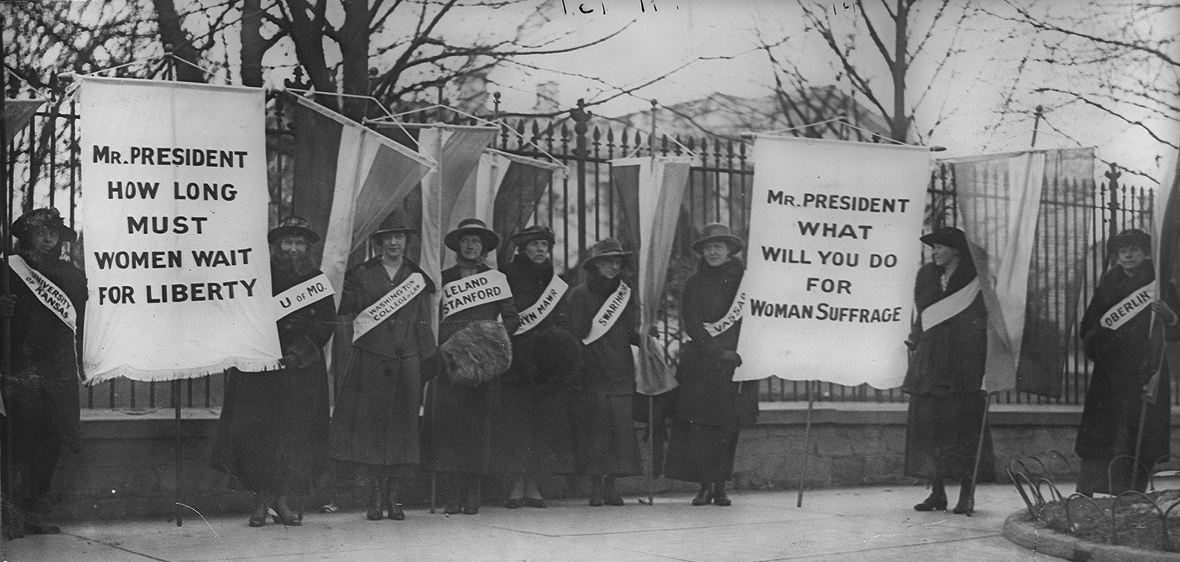
| Women suffragists picketing in front of the White house, 1917 |
I still have a dream. That's just the way I am, ever hopeful, ever looking forward. But the future now is uncertain, perhaps even volatile. One can feel the volatility like the first rumblings of an earthquake. So we must steady ourselves, seek shelter when necessary, but never forget that as a society we always pick up the pieces and rebuild. That's what we do. That's what I do.
Saturday, August 20, 2016
Late Summer Acorns
This time of year I lie in bed and listen to acorns plop as they drop off the oak tree in front of our house. Before I go to sleep, when I wake up during the night, and when I lie in bed absorbing the sweet quiet and goodness of morning, I hear them fall. One by one. Sometimes they bounce, and I hear a few rapid plops in a row. Sometimes they hit the metal roof of our wood shed, and the sound is sharp like a bang. But most of the acorns hit the wooden porch or steps, or the shingled house roof, and the sound is robust but dull, like a strike on a kettledrum.Like the glorious sound of birds singing in March as they arrive from the south, the rumble of the first thunderstorm in April, the buzz of cicadas in late summer, the falling of acorns is a sound that for me marks time. Dipping a spoon to get that first delectable taste of maple syrup from the pot boiling in the shed; admiring the beauty of the first brook trout caught in the spring; picking bright red raspberries up the Mt. Chase road in August for muffins; grabbing my orange jacket and shotgun to go grouse hunting with my very excited dogs on the first day of October; filling the woodstove on a cold day in December for the first fire of the winter. There is indeed a season for everything. We eagerly await each one, even though they remind us that time seems to move far too quickly and nothing lasts forever. The raspberries will be gone, the trout will go to deep waters for the summer, the acorns will eventually stop falling . . . until next time. So we wait until next time, doing whatever keeps us busy in the moment.

Time isn't linear; it's a revolving circle, the embodiment of perfection and eternity. We go round and round, enjoying the view and resting in eternity.
Sunday, July 3, 2016
Elie Wiesel
![]() |
| Elie Wiesel 1928-2016 |
Growing older means facing loss over and over again. It is what it is. Recently, though, a number of people have died who played a huge role in my personal growth and development of my spirit, values, goals, and attitudes. And, another one yesterday, Elie Wiesel.
More will die; I cannot stop that. But I can help keep their truth alive; we all can, and must. Wiesel and others like him, through their words and actions, fundamentally alter the air we all breathe. It's up to the rest of us to sustain that. So, breathe deeply of that air today. Hold it in. Feel its goodness, its grace. Then send it back out into the universe with your wish that it may continue to journey through the universe, growing ever stronger and more vigorous.
"Think higher and feel deeper."
— Elie Wiesel
https://commons.wikimedia.org/wiki/File:Elie_Wiesel.jpg
Trust
Some days everything fits together . . . no
rough edges, no sharp objects, no puzzle pieces missing. Balance and
equilibrium in every moment. I feel as if I blend in . . . part of the flow.
Nothing special, nothing distinctive.
But other times, obstacles are everywhere. Rough edges, sharp
objects, locked doors, barricades. I stumble, lose my balance, get scraped
and jabbed. Bleed and bruise. Why me? Me? Me?
Is it the stars, my hormones, or did I get out of bed on the wrong
side? Will things be better if I take my vitamins, have a cup of coffee, or go
for a walk?
I don’t know. But just as I ponder these questions, a voice
from somewhere says: “Don't compare. Be fully present to every moment. Be here . . . now. Be present . . . and trust.
https://upload.wikimedia.org/wikipedia/commons/4/43/2006-01-14_Surface_waves.jpg
Monday, June 13, 2016
Christine-in-the-Pulpit
I love Jack-in-the-Pulpit. It's my favorite flower, and I'm guessing
you never heard anyone say that. It's a funny color for a flower . . .
mostly green and very deep red, almost brown. Also a curious shape . . .
a kind of pouch with a flap very nearly enclosing a generously sized
stalk . . . "Jack" being the stalk and the "pulpit" being the pouch.
Then too there is the fact that you have to be on your hands and knees
to see one of these things, as they grow six to twelve inches off the
ground, nearly hidden by the plants two large leaves. But I truly love
it and eagerly await its arrival every spring.
My home in
mid-coast Maine (south of Downeast and north of Portland) sits on a
large five-acre lot in the woods. Tall white pines, hemlock, spruce,
some oak, sugar maple, red maple, poplar, beech, a few birch, and a
couple of crabapple trees that birds must have planted some years ago.
Also lots of ferns, violets, bluets, paintbrush, raspberries,
blackberries, and goldenrod. The first wildflowers to bloom in the
spring are anemone, trout lily, violets, bluets, and trillium. And by
the end of May, Jack-in-the-Pulpit is ready for its very subtle show.
I've
been in my house for close to twenty-five years, and I've spent
thousands of hours in my woods—walking, snow-shoeing, picking flowers,
studying plant life, clearing unwanted brush, sawing dead limbs, picking
up sticks, watching baby birds and their mothers in their nests, and on
and on. For a very long time the only Jack-in-the-Pulpit I was aware of
was a grouping of five or six plants that came up every year just in
front of a birch tree about thirty feet from my sunroom. I looked for
them every spring and throughout the summer would make a point to stop
to look at them, always trying to keep my dogs from stomping on them
while I bent down to enjoy them. Several years ago I found a few other
small and immature groupings and had the idea to try to replant them in
my various gardens—around the house, around the garage, along both sides
of the long driveway, and in front of the wooden fence that outlines
one side of the front lawn. Some wild plants do not transplant well:
Lady Slipper is one good example; best to leave them wherever you find
them. But that's never been a problem with Jack-in-the-Pulpit. So for
the last several years I've been spreading these unique plants all over
the property. This year I realize I've been rewarded as I'm seeing
Jack-in-the-Pulpit everywhere!
A couple days ago I paused
to wonder why I like these plants so much; most people don't even know
they exist. The answer came to me rather quickly: they're a lot like me.
Jack-in-the Pulpit are happiest in the shady part of the woods where
sun is sparse and the ground is cool. They are shy and unassuming and
easily missed by those who walk by. They aren't colorful, but they are
unique. And, to get to know them, you have to put forth some effort.
Well . . . me too. I'm happiest in the woods: I love glorious tall trees
that tower above me, the cool and moist forest floor that supports
ferns and wildflowers and mushrooms, the sound of the wind in the
leaves, and the smell of pine and spruce after a rain. I too am shy and
reserved and easily missed. I'm not loud or brash or flamboyant, but I
like to think I'm one-of-a-kind. I'm careful about who I allow in to get
to know me and I open up slowly but generously. I'd be very happy to be
perched on the forest floor, lovingly protected by a couple of large
leaves. So now, dear Jack-in-the-Pulpit, I understand.
Monday, May 30, 2016
Jack-in-the-Pulpit
It's spring in the north woods!Jack in the pulpit Preaches to-day,
Under the green trees
Just over the way.
Squirrel and song-sparrow,
High on their perch,
Hear the sweet lily-bells
Ringing to church.
Come, hear what his reverence
Rises to say,
In his low painted pulpit
This calm Sabbath-day.
Fair is the canopy
Over him seen,
Penciled by Nature’s hand,
Black, brown, and green.
Green is his surplice,
Green are his bands;
In his queer little pulpit
The little priest stands.
In black and gold velvet,
So gorgeous to see,
Comes with his bass voice
The chorister bee.
Green fingers playing
Unseen on wind-lyres,
Low singing bird voices,–
These are his choirs.
The violets are deacons–
I know by the sign
That the cups which they carry
Are purple with wine.
And the columbines bravely
As sentinels stand
On the look-out with all their
Red trumpets in hand.
Meek-faced anemones,
Drooping and sad;
Great yellow violets,
Smiling out glad;
Buttercups’ faces,
Beaming and bright;
Clovers, with bonnets,–
Some red and some white;
Daisies, their white fingers
Half-clasped in prayer;
Dandelions, proud of
The gold of their hair;
Innocents,–children
Guileless and frail,
Meek little faces
Upturned and pale;
Wild-wood geraniums,
All in their best,
Languidly leaning
In purple gauze dressed:–
All are assembled
This sweet Sabbath-day
To hear what the priest
In his pulpit will say.
Look! white Indian pipes
On the green mosses lie!
Who has been smoking
Profanely so nigh?
Rebuked by the preacher
The mischief is stopped,
But the sinners, in haste,
Have their little pipes dropped.
Let the wind, with the fragrance
Of fern and black birch,
Blow the smell of the smoking
Clean out of the church!
So much for the preacher:
The sermon comes next,–
Shall we tell how he preached it,
And where was his text?
Alas! like too many
Grown-up folks who play
At worship in churches
Man-builded to-day,–
We heard not the preacher
Expound or discuss;
But we looked at the people,
And they looked at us.
We saw all their dresses,
Their colors and shapes;
The trim of their bonnets,
The cut of their capes.
We heard the wind-organ,
The bee, and the bird,
But of Jack in the pulpit
We heard not a word!
— Clara Smith
Subscribe to:
Posts (Atom)


.jpg)